
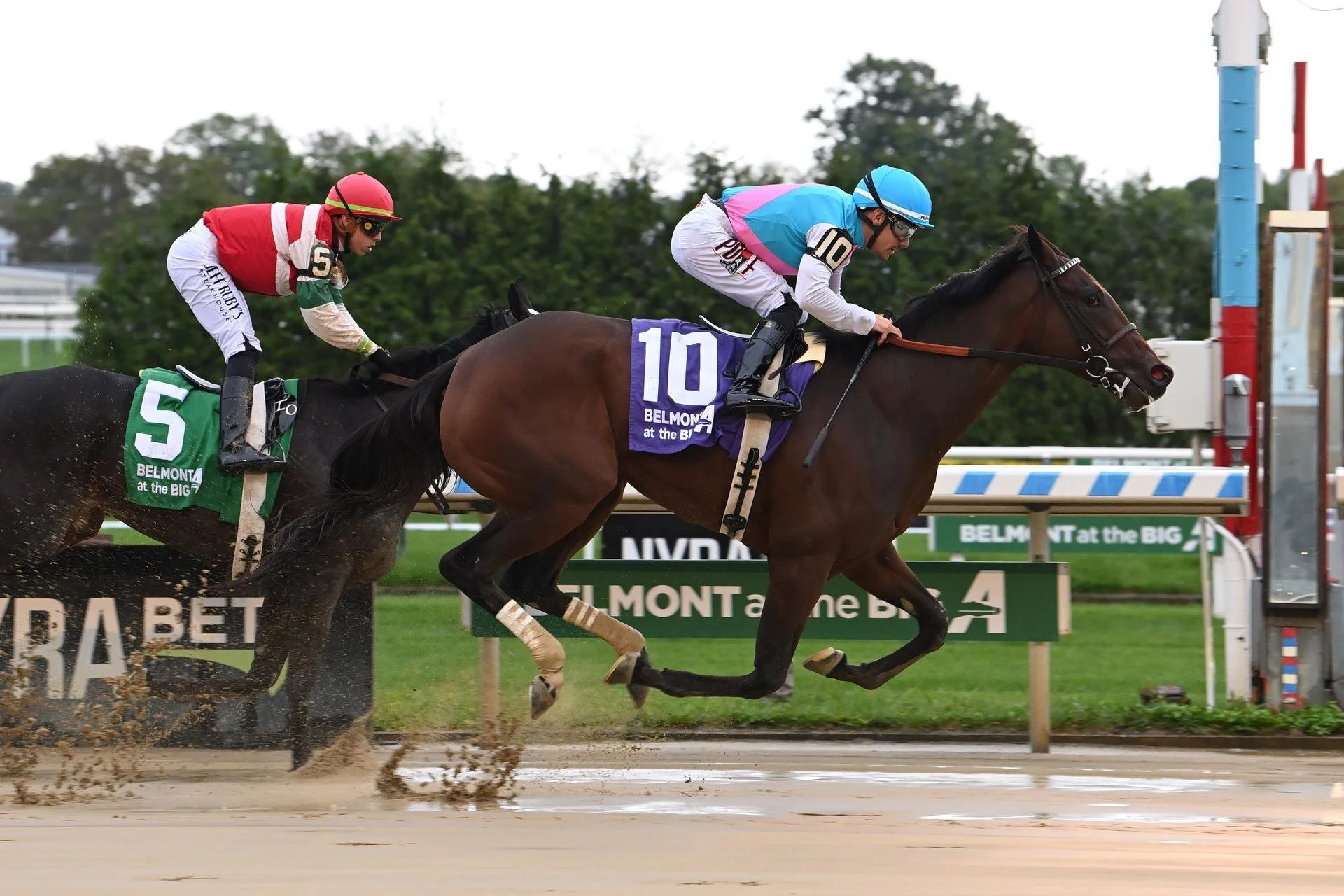
It's funny how the expression goes: maybe that horse can handle the turf better than the dirt. If you really think about it horses in their natural habitat do not run around on groomed dirt surfaces. They all run around on turf in one form or another. So to me, the question isn't whether a horse handles turf better than dirt, but whether a horse adapts better to a groomed dirt surface than to the surface its ancestors handled for millennia.
Horses may perform better on turf because their individual characteristics suit their stride, body mechanics, and running style. Sometimes it's as easy as a horse not wanting dirt kicked back in its face which can affect both vision and breathing.
Turf is a firm sometimes soft surface. Especially with fillies the fact that they have something under them to grab onto builds their confidence and allows them to relax and enjoy the trip.
The same horses may not be able to get hold of a dirt track. Because of their body mechanics and conformation, they may slip, slide and be unable to dig in. As a result, they flounder, climb, switch leads multiple times and if you see this happeining, you know that the horse is just not comfortable on a dirt surface.
When training a horse in the morning, you'll notice it may have high knee action, with its knees coming up high, almost to a right angle with its chest and breast plate. These horses were referred to as "daisy cutters". Old-timers used this term because it looked like horses were cutting the flowers off the daisies with their front and hind hooves. On a dirt track these horses may work very fast at 3/8s of a mile, but at a half mile, once their rider or a jockey sets them down to accelerate at the top of the stretch, they start to climb and perhaps begin to swhich leads which results in a weak finish.
Horses that run on turf last a little bit longer because you don't have the high-impact concussion that you would have on a dirt surface. Horses on the turf may relax more at the beginning of the race get into a good rhythm and galloping position going down the backstretch, and then kick out and accelerate at the top of the stretch turning for home. Often, if you notice a European horse in the field, the jock will place that horse behind others at the beginning of the race to encourage it to settle into a good galloping rhythm, as they are ready to go, go, go once the gates open. Then, at the top of the stretch, they move the horses out and let them finish the race at their own speed. This is as opposed to horses in a dirt race that are very aggressive from the start and really need to get an early lead or be up with the leaders and run from there.
Regarding footing on the different surfaces; Turf horses run over the top of the ground, whereas dirt horses dig into the dirt. Many factors, including body conformation (which determines body mechanics), genetics, and disposition, determine a horse's ability to run on different surfaces. Many times this may not become evident until the horse's first or second race. Many horses can fool you in the morning. Until you see them race against live competition in front of a cheering crowd you may not have all the information needed to properly determine their favorite distance and surface.
And that is what makes it such a fabulous sport. The horses can not talk, which is fabulous in many ways. They don't talk back, can't fail to show up for work, can not go on strike, and can notnegotiate contracts. At the same time one must determine through daily observation how they're feeling, when they are at their best and when they are ready to reward you with a demonstration of superior, athletic prowess. It takes a team effort to win a race. That's why we call it horse racing and not horse winning just like they call fishing, fishing and not catching. When an animal is central to the story, you don't know what will happen until you land it in your net or lead it into the Winner's circle!